


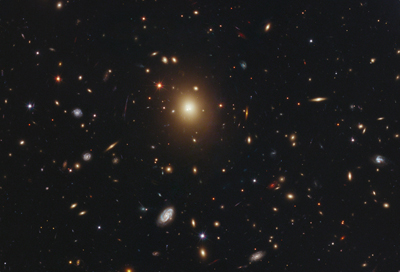
Astronomers using NASA's Hubble Space Telescope have obtained a remarkable new view of a whopper of an elliptical galaxy that may have been puffed up by the actions of one or more black holes in its core.
Spanning a little more than one million light-years, the galaxy is about 10 times the diameter of our Milky Way galaxy. The bloated galaxy is a member of an unusual class of galaxies with a diffuse core filled with a fog of starlight where there would normally be a concentrated peak of light around a central black hole. Viewing the core is like seeing a city with no downtown, just houses sprinkled across a vast landscape.
Spanning a little more than one million light-years, the galaxy is about 10 times the diameter of our Milky Way galaxy. The bloated galaxy is a member of an unusual class of galaxies with a diffuse core filled with a fog of starlight where there would normally be a concentrated peak of light around a central black hole. Viewing the core is like seeing a city with no downtown, just houses sprinkled across a vast landscape.


