Ads 468x60px

Showing posts with label Hubble. Show all posts

Sunday, March 24, 2013

Big Bang’s afterglow shows universe is 80 million years older than scientists first thought

ARIS — A new examination of what is essentially the universe’s birth certificate allows astronomers to tweak the age, girth and speed of the cosmos, more secure in their knowledge of how it evolved, what it’s made of and its ultimate fate.

Sure, the universe suddenly seems to be showing its age, now calculated at 13.8 billion years — 80 million years older than scientists had thought. It’s got about 3 percent more girth — technically it’s more matter than mysterious dark energy — and it is expanding about 3 percent more slowly.

Friday, March 22, 2013

Sideline quasars helped to stifle early galaxy formation

University of Colorado Boulder astronomers targeting one of the brightest quasars glowing in the universe some 11 billion years ago say "sideline quasars" likely teamed up with it to heat abundant helium gas billions of years ago, preventing small galaxy formation.

CU-Boulder Professor Michael Shull and Research Associate David Syphers used the Hubble Space Telescope to look at the quasar -- the brilliant core of an active galaxy that acted as a "lighthouse" for the observations -- to better understand the conditions of the early universe. The scientists studied gaseous material between the telescope and the quasar with a $70 million ultraviolet spectrograph on Hubble designed by a team from CU-Boulder's Center for Astrophysics and Space Astronomy.

Sunday, October 28, 2012

Monster Galaxy May Have Been Stirred Up By Black-hole Mischief

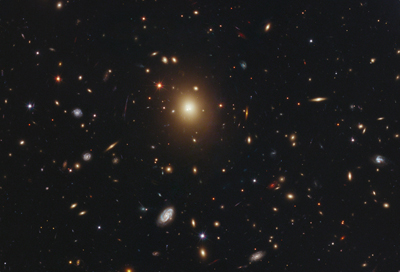
Astronomers using NASA's Hubble Space Telescope have obtained a remarkable new view of a whopper of an elliptical galaxy that may have been puffed up by the actions of one or more black holes in its core.

Spanning a little more than one million light-years, the galaxy is about 10 times the diameter of our Milky Way galaxy. The bloated galaxy is a member of an unusual class of galaxies with a diffuse core filled with a fog of starlight where there would normally be a concentrated peak of light around a central black hole. Viewing the core is like seeing a city with no downtown, just houses sprinkled across a vast landscape.

Saturday, October 27, 2012

Quasar May Be Embedded in Unusually Dusty Galaxy

Hubble astronomers have looked at one of the most distant and brightest quasars in the universe and are surprised by what they did not see: the underlying host galaxy of stars feeding the quasar. The best explanation is that the galaxy is shrouded in so much dust that the stars are completely hidden everywhere. Astronomers believe that the James Webb Space Telescope will reveal the galaxy.

All but the very first galaxies contain some dust-the early universe was dust-free until the first generation of stars started making dust through nuclear fusion. As these stars aged and burned out, they filled interstellar space with this dust as they lost their atmospheres.

Thursday, October 11, 2012

Астрономы перемерили расширение Вселенной

Группа астрономов с помощью космического телескопа НАСА Spitzer сделала наиболее точное измерение постоянной Хаббла, фундаментальной величины, которая показывает текущее ускорение расширения Вселенной.

Постоянная Хаббла названа в честь астронома Эдвина Хаббла, который удивил мир, обнаружив, что наша Вселенная расширяется и растет непрерывно с момента возникновения. Астрономы теперь знают, что Вселенная появилась на свет в результате Большого взрыва около 13,7 миллиардов лет назад. Определение постоянной Хаббла, прямое измерение скорости это расширения имеет решающее значение для измерения возраста и размеров нашей Вселенной.

Wednesday, October 3, 2012

Punctul dincolo de care nu mai există întoarcere: astronomii au reuşit să măsoare raza unei găuri negre

În astronomie, „graniţa de la care nu mai există întoarcere” marchează distanţa - faţă de gaura neagră - dincolo de care forţa gravitaţională este atât de puternică, încât nimic nu mai scăpa, nici măcar lumina. Totul este atras - fără posibilitate de întoarcere - către gaura neagră.

Este o premieră în lumea ştiinţifică: o echipă de astronomi de la Haystack Observatory, aparţinând de Massachusetts Institute of Technology (MIT), a măsurat raza unei găuri negre din centrul unei galaxii îndepărtate - distanţa până la care materia se poate apropia de gaura neagră fără a fi "înghiţită" de aceasta.

Friday, September 28, 2012

Cele mai îndepărtate obiecte astronomice

Galaxii, quasari, găuri negre, stele şi nebuloase – într-un cuvânt obiecte astronomice – sunt situate peste tot prin spaţiu, la diferite distanţe. În continuare vă prezentăm cele mai îndepărtate dintre aceste obiecte, care au cele mai mari deplasări spre roşu.

UDFj-39546284 este o structură stelară descoperită prin observaţii în infraroşu a telescopului spaţial Hubble. Aceasta are o deplasare spre roşu de aproximativ 10.3. După intense cercetări ale mai multor oameni de ştiinţă, în ianuarie 2011 s-a anunţat că lumina provenită de la acest obiect este cea mai veche din Univers. Sursa stelară propriu-zisă a luminii nici nu mai există. Aceasta este asociată cu o mini-galaxie de stele albastre care a existat aşa cum o vedem noi acum 13.2 miliarde de ani, la doar  480-500 milioane ani după Big Bang.

Thursday, September 27, 2012

Edwin Hubble – de la ochi la lentila la cele mai departate galaxii

Echipat cu cele cinci simturi, un om exploreaza universul din jurul lui si numeste aceasta aventura Stiinta. – Edwin Hubble, The Nature of Science, 1954

Inca de la o varsta frageda, Hubble a stiut ca vroia sa descopere tainele cerului, insa viata i-a oferit numeroase experiente (a fost avocat, a luptat in Primul Razboi Mondial, s-a specializat in matematica si astronomie) ca, intr-un final, sa il duca fata in fata cu visul sau si sa schimbe pentru totdeauna perceptia omului despre Univers.

Friday, September 14, 2012

Dark Energy Really IS Real

Our universe is a mysterious place. Only 4 percent or so is made up of the ordinary matter we see around us, including all those galaxies filled with stars. The rest, physicists believe, is made of up weakly interacting dark matter, and a mysterious substance called dark energy that is causing the cosmos to expand at an accelerating rate.

At least, that's the working hypothesis, and it seems to fit the data, although there are scientists who question its existence and tout alternatives to explain that accelerating expansion.

Thursday, September 13, 2012

Dovezi care sustin Big Bang-ul

Stiinta a avansat pana la punctul in care putem deduce ceva despre intregul univers. Acest lucru a fost o mare provocare avand in vedere cat de inimaginabil de vast este universul. 

Nenumaratele stele pe care le vedeti pe cer constituie abia 3000 de vecine din aproximativ 300 de miliarde de stele care se afla in galaxia noastra, iar in univers exista pana la 100 de miliarde de galaxii. Oamenii intotdeauna si-au pus urmatoarea intrebare: universul a existat mereu asa cum il vedem noi, sau acesta a inceput cumva brusc?

Saturday, September 8, 2012

Hubble Zooms in on the Center of M4

This new image from Hubble shows an up-close look at the center of M4 or Messier 4, a global cluster located in the constellation of Scorpius roughly 7,200 light-years away.

This sparkling picture taken by the NASA/ESA Hubble Space Telescope shows the center of globular cluster M4. The power of Hubble has resolved the cluster into a multitude of glowing orbs, each a colossal nuclear furnace.

M4 is relatively close to us, lying 7,200 light-years distant, making it a prime object for study. It contains several tens of thousands stars and is noteworthy in being home to many white dwarfs — the cores of ancient, dying stars whose outer layers have drifted away into space.

Saturday, July 21, 2012

New Singularity in Space-Time Found

Einstein’s theory of general relativity explains gravity as a curvature in space-time. But the theory starts from the assumption that any local patch of space-time looks flat, Temple said. But mathematicians at UC Davis "...show that space-time cannot be locally flat at a point where two shock waves collide,” said Blake Temple, professor of mathematics at UC Davis. “This is a new kind of singularity in general relativity.”

Hubble a descoperit o nouă galaxie de tip spirală

Astronomi de la Institutul de Astronomie şi Astrofizică Dunlap a Universităţii din Toronto au observat o galaxie ciudată de tip spirală, care pare să se fi format cu miliarde de ani înaintea alor spirale.

Astronomii au precizat că descoperirea lor este cel puţin ciudată, pentru că galaxia în cauză se găseşte la 10,5 miliarde de ani lumină de Pământ, ceea ce o plasează într-un moment când Universul avea doar trei miliarde de ani, perioadă în care spiralele de acest gen erau destul de rare.

Sunday, July 15, 2012

Calea Lactee şi Andromeda se vor contopi într-o unică galaxie. Ce se va întâmpla cu Sistemului Solar?

Calea Lactee va intra în coliziune cu galaxia Andromeda, rezultatul final fiind o unică galaxie eliptică, în care Sistemul Solar va supravieţui, însă îşi va schimba poziţia. Evenimentul însă nu trebuie să ne preocupe: coliziunea va avea loc peste circa 4 miliarde de ani.

După zeci de ani de speculaţii despre destinele galaxiei noastre, Calea Lactee, şi a celei vecine, Andromeda, astronomii de la Space Telescope Science Institute (STScI) din Baltimore, SUA, au ajuns la o concluzie clară: cele două galaxii vor intra în coliziune. Datele provenind de la telescopul NASA Hubble Space Telescope confirmă aceste previziuni.

Friday, July 13, 2012

New Moon for Pluto: Hubble Telescope Spots a 5th Plutonian Satellite

As humankind's first robotic visitor to Pluto approaches its destination, astronomers working to understand what it will find there have uncovered a tiny moon orbiting the dwarf planet.

The moon is the fifth known natural satellite of Pluto and has been informally labeled P5. It was discovered Saturday, July 7, in images taken by the Hubble Space Telescope as part of a campaign to identify possible hazards to the New Horizons spacecraft, now en route to Pluto for a 2015 flyby. Dust rings encircling Pluto, or small moons shedding unseen debris, could endanger the $700-million mission. So far, the search has not identified any dangerous dust bands around Pluto, but it has turned up two newfound moons—a small object called P4 last year, and now P5.