Ads 468x60px

Showing posts with label Max Planck. Show all posts

Sunday, March 24, 2013

Big Bang’s afterglow shows universe is 80 million years older than scientists first thought

ARIS — A new examination of what is essentially the universe’s birth certificate allows astronomers to tweak the age, girth and speed of the cosmos, more secure in their knowledge of how it evolved, what it’s made of and its ultimate fate.

Sure, the universe suddenly seems to be showing its age, now calculated at 13.8 billion years — 80 million years older than scientists had thought. It’s got about 3 percent more girth — technically it’s more matter than mysterious dark energy — and it is expanding about 3 percent more slowly.

Wednesday, October 31, 2012

Super-Massive Black Hole Inflates Giant Bubble

Like symbiotic species, a galaxy and its central black hole lead intimately connected lives. The details of this relationship still pose many puzzles for astronomers.

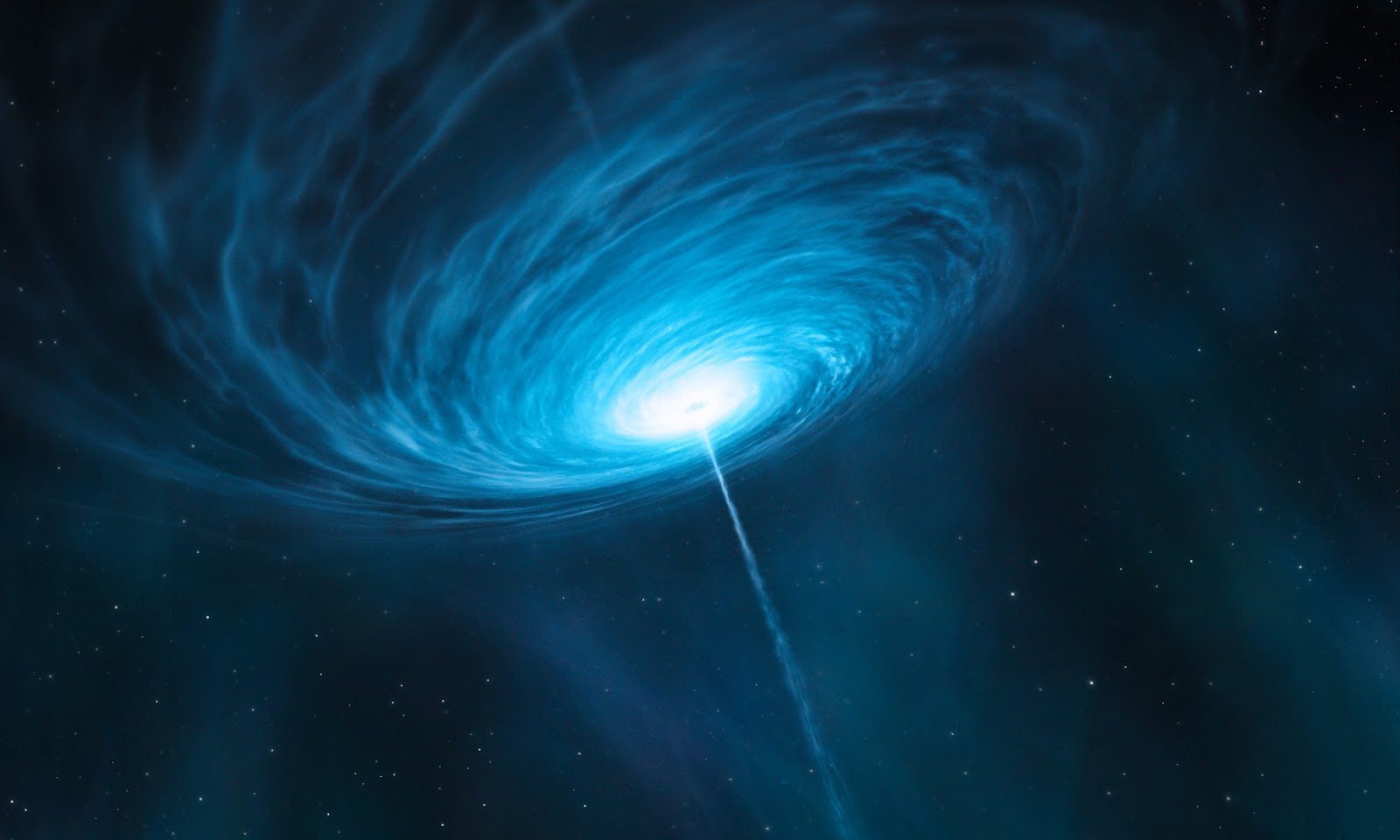
Some black holes actively accrete matter. Part of this material do not fall into the black hole but is ejected in a narrow stream of particles, traveling at nearly the speed of light. When the stream slows down, it creates a tenuous bubble that can engulf the entire galaxy. Invisible to optical telescopes, the bubble is very prominent at low radio frequencies. The new International LOFAR Telescope - designed and built by ASTRON in an international collaboration - is ideally suited to detect this low frequency emission.

Friday, October 5, 2012

Volcano Shoots Geyser Of Water Up Into Space

 What we have here is a moon — a small one (slightly wider than the state of Arizona) — circling Saturn.

If you look closely, you will see a small splay of light at its top, looking like a circular fountain.

That's because it is a fountain — of sorts. A bunch of volcano-like jets are sending fantastically high geysers of water vapor up into the sky, so high that you can see them in this remarkable print by Michael Benson, back lit by light bouncing off of Saturn.

Saturday, September 15, 2012

Solar and wind energy may stabilise the power grid

Renewable energies such as wind, sun and biogas are set to become increasingly important in generating electricity. If increasing numbers of wind turbines and photovoltaic systems feed electrical energy into the grid, it becomes denser – and more distributed. 

Saturday, September 8, 2012

Planck Satellite Observations May Help Solve the Mystery of Dark Matter

The Planck Satellite has observed a very unique emission of radio radiation from the center of the Milky Way, moving scientists closer than ever to a solution to the origin of dark matter.

The universe is comprised of a large amount of invisible matter, dark matter. It fills the space between the galaxies and between the stars in the galaxies. Since the prediction of the existence of dark matter more than 70 years ago, all sorts of researchers – astronomers, cosmologists and particle physicists have been looking for answers to what it could be. With the latest observations from the Planck satellite, researchers from the Niels Bohr Institute, among others, may be closer than ever to a solution to the origin of the mysterious dark matter.

Monday, August 13, 2012

Ce a fost inainte de Big Bang? Exista universuri paralele?

Huge Everett III, in 1954, afirma ca exista universuri paralele ca al nostru, toate fiind legate de el. In toate aceste universuri lucrurile se petrec diferit de al nostru. De exemplu, intr-unul oamenii au disparut deja, in altul razboaiele au finaluri diferite, specii disparute in universul nostru au evoluat diferit in alte universuri. Dar toate ,vedem, sunt legate, doar evenimentele se petrec diferit.

Saturday, July 28, 2012

How Hot Is the Hottest Star?

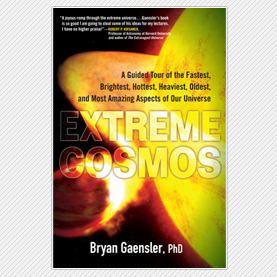
What's the densest object in the universe? The brightest? The loudest? In his new book Extreme Cosmos (Perigee, 2012), astronomer Bryan Gaensler reveals the cosmic record holders of these and many other titles. In an excerpt below, from the chapter "Extremes of Temperature," Gaensler explains the physics behind some of the hottest stars known:

We all know that if you heat something up, it glows. A poker in a fire shines a dull orange or red, while a conventional (incandescent) lightbulb works by heating up a tungsten filament to several thousand degrees so that it glows yellow or white. These are special cases of a universal process first properly explained by German physicist Max Planck: Virtually every object (whether on Earth or in space) radiates light, and the color of this light is tied to the object's temperature.

Thursday, July 26, 2012

A pulsar with a tremendous hiccup

Max Planck scientists discover a young and energetic neutron star with unusually irregular rotation

Pulsars are superlative cosmic beacons. These compact neutron stars rotate about their axes many times per second, emitting radio waves and gamma radiation into space.  Using ingenious data analysis methods, researchers from the Max Planck Institutes for Gravitational Physics and for Radio Astronomy, in an international collaboration, dug a very special gamma-ray pulsar out of data from the Fermi Gamma-ray Space Telescope. The pulsar J1838-0537 is radio-quiet, very young, and, during the observation period, experienced the strongest rotation glitch ever observed for a gamma-ray-only pulsar.

Saturday, July 21, 2012

Multi-Telescope View of Giant Black Hole Is 2 Million Times Sharper than Human Eye

Scientists using three telescopes spaced thousands of miles apart have caught the best look ever of the center of a distant quasar, an ultra-bright galaxy with a giant black hole at its core.

By linking powerful radio telescopes in Chile, Arizona and Hawaii together, astronomers created a deep-space observing system with 2 million times sharper vision than the human eye, which gave them the most detailed direct view ever of a supermassive black hole inside a galaxy 5 billion light-years from Earth.

Friday, July 20, 2012

Max Planck: On the Law of Distribution of Energy in the Normal Spectrum

The recent spectral measurements made by O. Lummer and E. Pringsheim, and even more notablethose by H. Rubens and F. Kurlbaum, which together confirmed an earlier result obtained by H. Beck-mann, show that the law of energy distribution in the normal spectrum, first derived by W. Wien frommolecular-kinetic considerations and later by me from the theory of electromagnetic radiation, is notvalid generally.

In any case the theory requires a correction, and I shall attempt in the following to accomplishthis on the basis of the theory of electromagnetic radiation which I developed. For this purpose it willbe necessary first to find in the set of conditions leading to Wien’s energy distribution law that termwhich can be changed; thereafter it will be a matter of removing this term from the set and making an appropriate substitution for it.

Wednesday, July 4, 2012

Giant Galactic Collision Imminent

A GIANT GAS CLOUD is on a collision course with our galaxy’s supermassive black hole. Researchers are watching the first scenes of a cosmic show that’s expected to heat up over the next year as a giant gas cloud approaches the supermassive black hole at the center of our galaxy.

The impending collision was the subject of a research paper published in Nature last December, and now the European Research Media Center is providing an update: By mid-2013, the cloud is expected to pass in the vicinity of the black hole, known as Sagittarius A*, at a distance of 36 light-hours, or less than 25 billion miles (40 billion kilometers).