Ads 468x60px

Showing posts with label Quasar. Show all posts

Wednesday, September 4, 2013

Milky Way Gas Cloud Causes Multiple Images of Distant Quasar

For the first time, astronomers have seen the image of a distant quasar split into multiple images by the effects of a cloud of ionized gas in our own Milky Way Galaxy. Such events were predicted as early as 1970, but the first evidence for one now has come from the National Science Foundation's Very Long Baseline Array (VLBA) radio telescope system.

The scientists observed the quasar 2023+335, nearly 3 billion light-years from Earth, as part of a long-term study of ongoing changes in some 300 quasars. When they examined a series of images of 2023+335, they noted dramatic differences. The differences, they said, are caused by the radio waves from the quasar being bent as they pass through the Milky Way gas cloud, which moved through our line of sight to the quasar.

Friday, March 22, 2013

Sideline quasars helped to stifle early galaxy formation

University of Colorado Boulder astronomers targeting one of the brightest quasars glowing in the universe some 11 billion years ago say "sideline quasars" likely teamed up with it to heat abundant helium gas billions of years ago, preventing small galaxy formation.

CU-Boulder Professor Michael Shull and Research Associate David Syphers used the Hubble Space Telescope to look at the quasar -- the brilliant core of an active galaxy that acted as a "lighthouse" for the observations -- to better understand the conditions of the early universe. The scientists studied gaseous material between the telescope and the quasar with a $70 million ultraviolet spectrograph on Hubble designed by a team from CU-Boulder's Center for Astrophysics and Space Astronomy.

Tuesday, March 12, 2013

Extremely rare triple quasar found

An infrared image of the triple quasar system QQQ J1519+0627, made using the 3.5-m aperture telescope of the Calar Alto Observatory. The three quasars are labelled A, B and C. Credit: Emanuele Paolo Farina

(Phys.org) —For only the second time in history, a team of scientists—including Carnegie's Michele Fumagalli—have discovered an extremely rare triple quasar system. Their work is published by Monthly Notices of the Royal Astronomical Society.

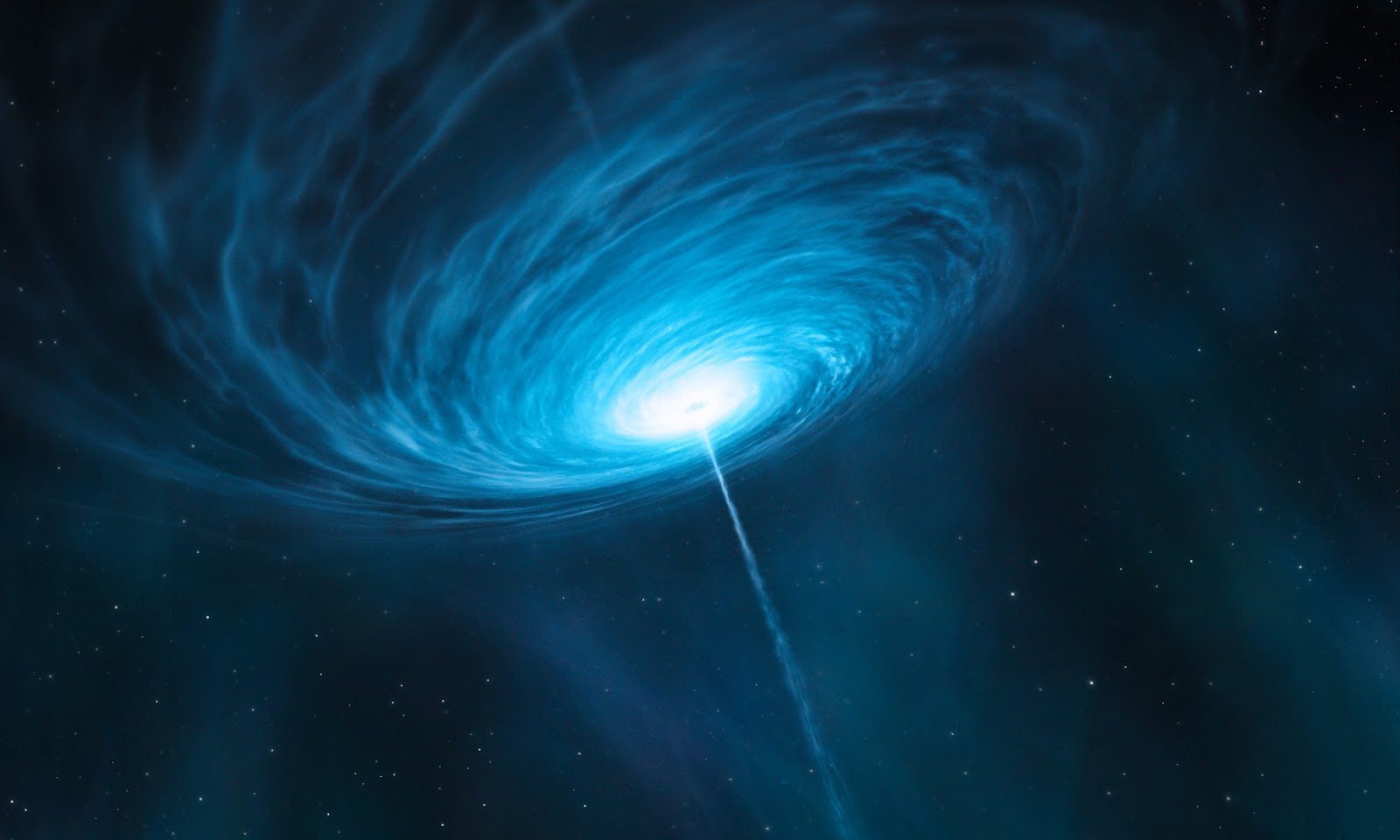
Quasars are extremely bright and powerful sources of energy that sit in the center of a galaxy, surrounding a black hole. In systems with multiple quasars, the bodies are held together by gravity and are believed to be the product of galaxies colliding.

Wednesday, November 14, 2012

Квазары помогли астрономам в изучении барионных осцилляций

Ученые из коллаборации BOSS (Baryon Oscillation Spectroscopic Survey, Спектроскопический обзор барионных осцилляций) опубликовали результаты изучения темной энергии с помощью барионных акустических осцилляций. Статья исследователей подана в журнал Astronomy and Astrophysics, а ее препринт доступен на сайте arXiv.org.

Главная цель коллаборации BOSS - изучение так называемых барионных акустических осцилляций. Это акустические волны, образовавшиеся вскоре после рождения Вселенной, которые, как считается, отвечают за неравномерное распределение материи в космосе, а также анизотропию реликтового излучения.

Saturday, October 27, 2012

Quasar May Be Embedded in Unusually Dusty Galaxy

Hubble astronomers have looked at one of the most distant and brightest quasars in the universe and are surprised by what they did not see: the underlying host galaxy of stars feeding the quasar. The best explanation is that the galaxy is shrouded in so much dust that the stars are completely hidden everywhere. Astronomers believe that the James Webb Space Telescope will reveal the galaxy.

All but the very first galaxies contain some dust-the early universe was dust-free until the first generation of stars started making dust through nuclear fusion. As these stars aged and burned out, they filled interstellar space with this dust as they lost their atmospheres.

Friday, October 5, 2012

Gone, With the Wind

The case of the missing quasar gas clouds has been solved by a worldwide team of astronomers, and the answer is blowin' in the wind. Astronomers Nurten Filiz Ak and Niel Brandt of the Pennsylvania State University led the team, which announced their results in a paper published in The Astrophysical Journal. The paper describes 19 distant quasars in which giant clouds of gas seemed to disappear in just a few years.

"We know that many quasars have structures of fast-moving gas caught up in 'quasar winds,' and now we know that those structures can regularly disappear from view," says Filiz Ak, a graduate student at Penn State and lead author of the paper. "But why is this happening?"

Tuesday, October 2, 2012

Quasarii, borne ale expansiunii universului

Oamenii de ştiinţă nu pot călători departe în spaţiul cosmic, aşa cum Columb a navigat şi descoperit America. Cercetătorii de la Univ. Case Western Reserve şi două instituţii partenere au găsit o metodă de a cartografia întinderea şi structura universului.

Această tehnică (care se ghidează după lumina quasarilor), combinată cu speranţa descoperirii a milioane de quasari distanţi în decada următoare, ar putea produce o perspectivă inedită asupra trecutului cosmosului, foarte aproape de perioada de după marea explozie, când Universul avea doar o fracţiune minusculă din mărimea pe care o are în prezent.

Thursday, September 27, 2012

NASA descoperă milioane de noi quasari

Telescopul WISE al NASA a cercetat de două ori Universul în timpul misiunii sale de 14 luni, generând un număr impresionant de date. În urma analizei acestor date, astronomii au scos la iveală una dintre cele mai impresionante descoperiri de până acum.

Este vorba de existenţa a 2,5 milioane de găuri negre răspândite prin cosmos – de aproximativ trei ori mai multe decât cele descoperite de cercetări precedente.

Tuesday, July 24, 2012

The antediluvian world

Although various ancient traditions refer to a lost antediluvian world, the one that stands out is the tradition in the early chapters of Genesis, because of its geographical detail, its monotheism (which has been shown to predate polytheism) and its historical (rather than epic) style of narration. These chapters describe a world very different from our own, either because the world really was different or because a later pre-scientific culture speculated about it in error. So what source of information did they draw upon?

Saturday, July 21, 2012

Multi-Telescope View of Giant Black Hole Is 2 Million Times Sharper than Human Eye

Scientists using three telescopes spaced thousands of miles apart have caught the best look ever of the center of a distant quasar, an ultra-bright galaxy with a giant black hole at its core.

By linking powerful radio telescopes in Chile, Arizona and Hawaii together, astronomers created a deep-space observing system with 2 million times sharper vision than the human eye, which gave them the most detailed direct view ever of a supermassive black hole inside a galaxy 5 billion light-years from Earth.