Ads 468x60px

Tuesday, October 16, 2012

The Hobbit Was An Actual Ancient Human

This December, Director Peter Jackson’s film, “The Hobbit,” hits theaters.

This film version of J. R. R. Tolkien’s classic fantasy novel of the same name features the adventures of small humanoid race that stands about two to four feet tall.

Though these creatures inhabit the fictional world of Middle Earth, scientists have discovered that an actual hobbit-like species of humans existed during pre-historic times. Leading into the idea that the Earth was home to three different species of humans: homosapiens, Neanderthal, and now the Hobbit.

Pakal’s Son Kan Balam Tomb Found in Palenque

A huge archaeology discovery has been found in Palenque, Mexico. After decades of searching, the tomb of Pakal the Great’s son Kan Balam II has been discovered near the Temple of the Foliated Cross.

Has the tomb of King Kan Balam II, the son of Pakal the Great finally been found in Palenque?   Although archaeologists have been searching for this tomb for decades now, there has never been anything found of his remains.  But now that may have changed.  A group of amateur explorers has announced on several TV stations in Mexico that they have found the missing tomb near the Temple of the Foliated Cross (pictured below).  What is intriguing is that this building was constructed during the reign of Kan Balam II and was one of the places that archaeologists thought the King could be buried at.

Wonders of the modern world: Chichen Itza

Some of the most incredible pyramids still in existence are not, as many people erroneously think, in Egypt, but are in South America where they continue to fascinate astronomers, archaeologists and tourists alike.

Of these awe-inspiring edifices it is perhaps Chichen Itza, on the Yucatan Peninsula, in what is modern day Mexico and which, to the delight of many, is listed as one of the ‘Wonders of the Modern World’, that is the most famous, although Machu Pitchu in Peru does compete for this honour.

First look at “Noah’s” ark revealed

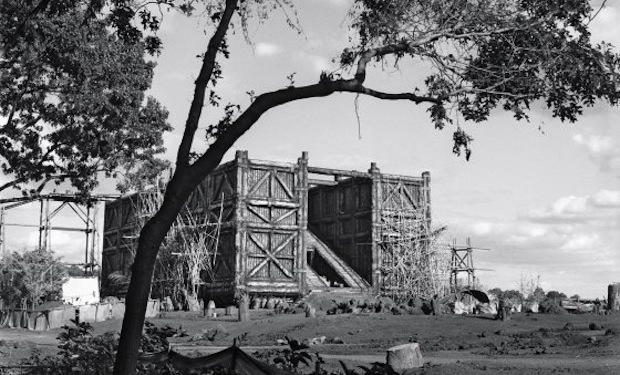
A behind-the-scenes photo reveals the ark from Darren Aronofsky's upcoming film.

This time it was Darren Aronofsky and not Noah who built the ark.

Vulture has snapped the first image of the still under construction ark from the upcoming biblical epic “Noah,” and it looks fantastic. Aronofsky is apparently hard at work building the massive set in Long Island, and it certainly does seem large enough to fit two of every animal in the world. At least Aronofsky felt the need to built the ship in person instead of relying on CGI like other directors might have done.

Mayan astronomy, society, cosmology, & timekeeping

As December 2012 approaches -- and with it the supposed end of the fabled Mayan Long Count calendar -- popular references to a Maya predicted doomsday will reach a crescendo. Recently at SFI, a small group gathered for a quieter and far more scholarly approach to understanding the early Maya.

The three-day SFI working group in August brought together experts in Maya archaeoastronomy to pursue questions central to both to astronomy and complex civilizations.

“With the rapid increase in archaeological knowledge about early Maya cities, their architecture and urban forms, new information from hieroglyphic decipherment, and recent advances in understanding ancient Maya iconography, the opportunity for new insights into the role of astronomy in the development of ancient Maya civilization could not be better,” says SFI President Jerry Sabloff, who participated in the meeting.

Radiaţia Hawking, aproape de a fi testată?

Într-un laborator din Scoţia un tip de laser revoluţionar începe să devină realitate, primul de acest gen făcut dintr-o gaură neagră artificială. Odată finalizat, dispozitivul ar putea a ajuta la confirmarea indiciilor că găurile negre adevărate, în ciuda numelui lor, emit lumină.

Un laser gaură neagră poate avea şi utilizări practice în cadrul dispozitivelor care sondează proprietăţile unui material fără a-l distruge.

În inima unui asemenea laser se petrece un fenomen pe care Stephen Hawking l-a prezis în anii 1970 şi pe care fizicienii l-au vânat încă de atunci. Deşi nici chiar lumina nu poate scăpa de gravitaţia lor, Hawking a calculat că găurile negre ar trebui chiar şi aşa să emită o lumină slabă, numită acum radiaţia Hawking.

Monday, October 15, 2012

Zeugma After the Flood

It wasn't good policy that saved ancient Zeugma. It was a good story. In 2000, the construction of the massive Birecik Dam on the Euphrates River, less than a mile from the site, began to flood the entire area in southern Turkey. Immediately, a ticking time-bomb narrative of the waters, which were rising an average of four inches per day for six months, brought Zeugma and its plight global fame. The water, which soon would engulf the archaeological remains, also brought increasing urgency to salvage efforts and emergency excavations that had already been taking place at the site, located about 500 miles from Istanbul, for almost a year.

Saudi eases access to long-hidden ancient ruins

AL-HIJR, Saudi Arabia — Fully draped in a black veil, Irish blonde Angela Miskelly stares out in awe as she strolls through Al-Hijr, the ancient Saudi city of tombs carved into rose-coloured sandstone mountains.

"Spectacular... wonderful... breathtaking," she says. "But where are the tourists? If we had a site like this in my country, we would have millions of tourists!"

Dating back to the second century BC, the Nabataean archaeological site, also known as Madain Saleh, has long been hidden from foreign visitors in this ultra-conservative kingdom that rarely opens up to tourists.

Choquequirao: Re-discovering Machu Picchu's 'sacred sister'

I'm seated cross-legged on a narrow terrace thousands of feet above the raging Apurimac River, the jagged silhouettes of the Peruvian Andes before me, the glowing stones of a 15th-century Incan wall warming my back.

And all I can think about is how insanely lucky I am to have this place all to myself.

Thirty miles away as the crow flies, thousands of sweaty, camera-toting tourists are jockeying for position in various lines at Machu Picchu: one to purchase a few squares of toilet paper; one to climb the sacred Huayna Picchu Mountain; another to board one of the smoke-belching people-movers that deliver roughly 3,000 pilgrims daily to the world-famous archeological site.

Tomb of Mayan snake lord discovered in Guatamala

Archaeologists say they've discovered what could be the tomb of one of the greatest Mayan rulers, the seventh-century warrior queen Lady K'abel.

The tomb was revealed during digging at the ancient Maya city of El Perú-Waka' in the rain forest of northern Guatemala. Alongside the body, excavators found a white jar shaped like a conch shell with the head and arm of a woman carved at the opening. The artifact had four hieroglyphs that suggest it belonged to K'abel.