


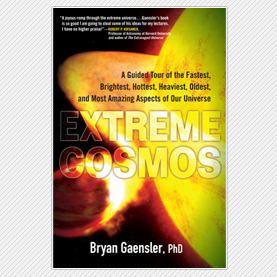
What's the densest object in the universe? The brightest? The loudest? In his new book Extreme Cosmos (Perigee, 2012), astronomer Bryan Gaensler reveals the cosmic record holders of these and many other titles. In an excerpt below, from the chapter "Extremes of Temperature," Gaensler explains the physics behind some of the hottest stars known:
We all know that if you heat something up, it glows. A poker in a fire shines a dull orange or red, while a conventional (incandescent) lightbulb works by heating up a tungsten filament to several thousand degrees so that it glows yellow or white. These are special cases of a universal process first properly explained by German physicist Max Planck: Virtually every object (whether on Earth or in space) radiates light, and the color of this light is tied to the object's temperature.
We all know that if you heat something up, it glows. A poker in a fire shines a dull orange or red, while a conventional (incandescent) lightbulb works by heating up a tungsten filament to several thousand degrees so that it glows yellow or white. These are special cases of a universal process first properly explained by German physicist Max Planck: Virtually every object (whether on Earth or in space) radiates light, and the color of this light is tied to the object's temperature.


